The Architecture Decisions That Make or Break Your Scale Story
· Updated
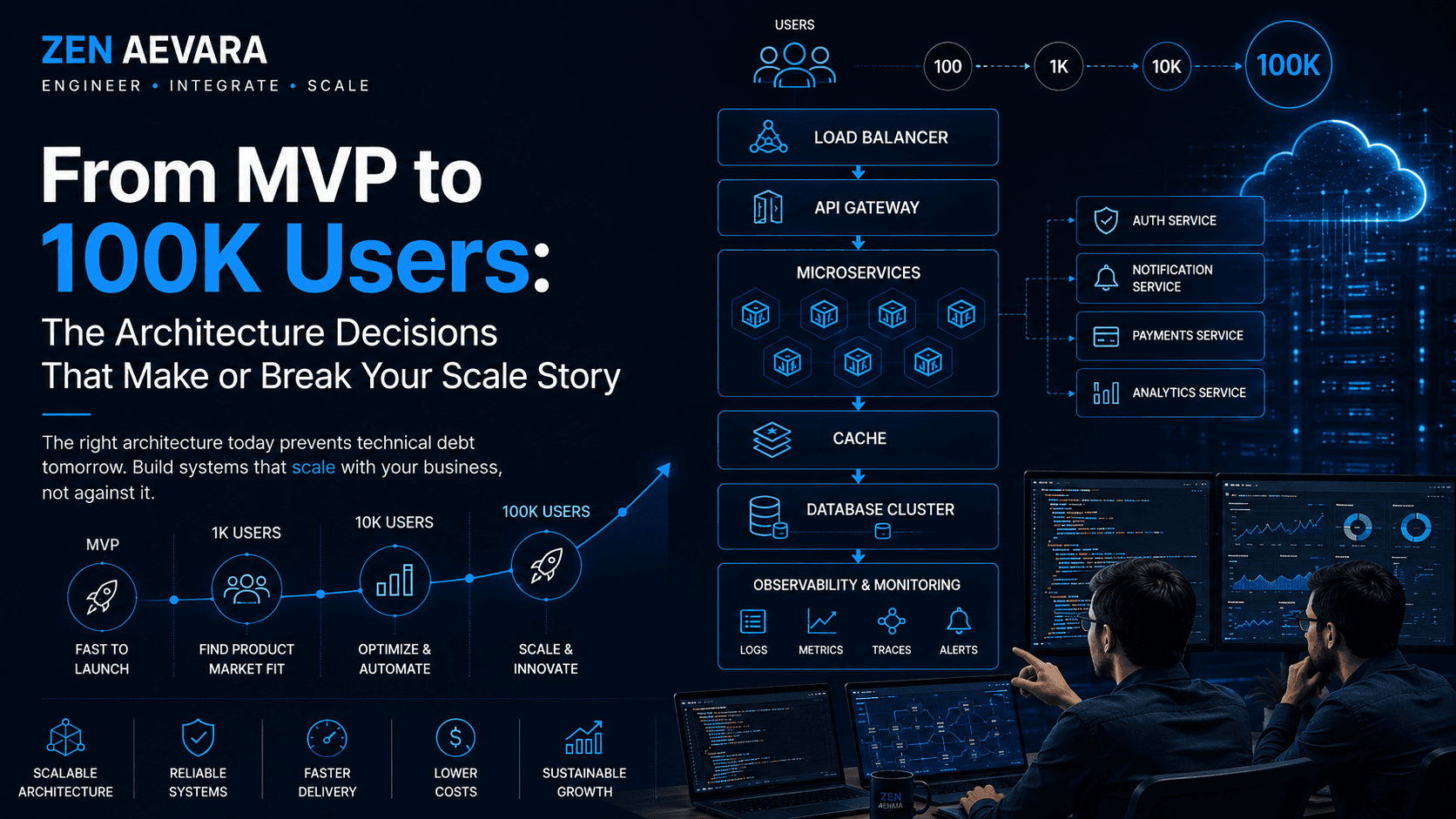
From MVP to 100K Users: The Architecture Decisions That Make or Break Your Scale Story Launching fast is smart. But the technical decisions made during an MVP — the ones that felt like "good enough for now" — become either a competitive advantage or your biggest liability within eighteen months. Most teams don't realize this until they're already living inside the consequences.
The Trap of MVP-Forever Architecture An MVP architecture is optimized for speed of delivery. A production-scale architecture is optimized for reliability, performance, and maintainability. Most teams end up stuck somewhere between the two — the system grew, but the architecture didn't evolve with it. The symptom is familiar: deployments take hours, new developers take weeks to get productive, one database table is handling eight different concerns, and every new feature risks breaking two others. This isn't a code quality problem. It's architecture debt — and it compounds faster than financial debt.
The Decisions That Matter Most, Early The choices that determine scale are usually invisible at the time they're made. How the data model is structured and what boundaries exist between domains determines the cost of every future feature. Getting this wrong means refactors that touch dozens of files just to add a new column. Getting it right means new capabilities slot in without disturbing existing ones. Similarly, whether processing happens synchronously or asynchronously has consequences that only reveal themselves at load. When everything in a system is synchronous — requests waiting on requests waiting on database calls — the latency floor is fixed and the scale ceiling is low. Introducing async processing for the right operations early creates architectural headroom that pays dividends when it matters most.
Infrastructure and Observability Are Not Phase Two Infrastructure-as-code is a decision teams routinely defer and later regret. Teams that skip it during the MVP phase spend months retrofitting it under pressure, when production is already live and stakes are high. Starting with infrastructure defined in code means every environment is reproducible, every change is audited, and scaling becomes a configuration change rather than a manual operation. Observability follows the same logic. You cannot optimize what you cannot measure, and tracing, structured logging, and alerting built in from the start means that when something goes wrong at scale — and something always does — you find it in minutes, not hours.
How ZEN AEVARA Thinks About Architectural Decisions At ZEN AEVARA, we don't design for hypothetical scale. We design for the next two meaningful growth stages, with clear decision points built in for when the architecture needs to evolve. That produces fewer big-bang rewrites and more deliberate incremental upgrades. The goal is an architecture that supports the business at every stage — not one that heroically handles infinite load on paper but collapses under the first real traffic spike. Whether you're designing a new system or untangling an existing one, architectural clarity is an investment with a fast return.